

The Fink model still holds — but the world it applies to has been transformed from the ground up. Four major disruptions have redefined the timeline of a crisis dynamics, and AI is the primary accelerator.
Every crisis follows a dynamic that evolves through clearly identifiable phases. Knowing which phase you are in brings clarity and enables better decisions about what lies ahead.
The reference model remains Steven Fink’s, published in 1986: four sequential stages — prodromal, acute, chronic, resolution — to which consultant Alan Hilburg responds with three segments (avoidance, mitigation, recovery). Its structure remains valid. Everything else has changed.
- Why the Fink model can no longer be applied as-is
- The false trough trap
- The 6 phases of the new dynamic
- The 15–60–90 rule
- What this means for you
Why Fink Can No Longer Be Applied As-Is
Published in 1986, Steven Fink‘s Crisis Management: Planning for the Inevitable is the founding work of modern crisis management. It describes a four-stage dynamic: prodromal (weak signals), acute (trigger), chronic (lasting effects), and resolution.
This model remains a reference. But forty years later, the world has changed. In 1986, a crisis unfolded over days, sometimes weeks. Organizations had time to consult their lawyers, prepare their messages, and choose their moment. That world is gone.
Four disruptions summarize this change.
| Disruption 1 — The Compression of Time | Disruption 2 — The Loss of the Information Monopoly |
|---|---|
| What took 48 hours in 1986 can now happen in 48 minutes. The prodromal phase is often already public on social media before the organization has been informed internally. | Any employee, customer, or witness can publish in real time. The organization’s silence is instantly filled by other voices — often less well-informed ones. |
| Disruption 3 — AI as a Crisis Accelerator | Disruption 4 — Digital Persistence |
| Thousands of fake messages generated in seconds, cloned executive voices, indistinguishable fraudulent documents. AI artificially amplifies the perceived intensity of the crisis. | A resolved crisis remains indexed, archived, cited. A 2025 crisis can resurface in a 2027 article. Resolution no longer erases — it adds to the public record. |
“The acute phase, which used to be a gradual arc, has become a vertical spike. The organization is at peak crisis before it has even activated its crisis team.”
The False Trough Trap
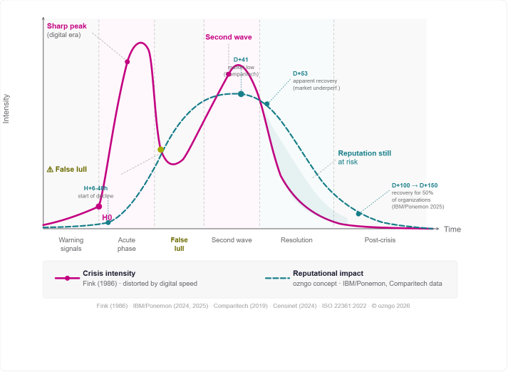
In contemporary crises — recurring cyberattacks, multi-wave disinformation campaigns, crises with media rebounds — the intensity curve may show a lull.
The organization, exhausted from the acute phase, interprets this trough as the beginning of resolution and may stand down its crisis team. That is precisely when a second wave strikes, often more devastating, because defenses have been let down and reputation is already weakened.
This is a widely shared warning among crisis management practitioners: never declare a crisis over solely on the basis of a lull. Resolution must be confirmed, documented, and maintained — not merely felt.
The 6 Phases of the New Crisis Dynamic
The adapted Fink model integrates new temporal benchmarks, the reputational dimension, and the false trough. Here are the decisive actions at each phase:
A New Curve Takes Shape
The crisis dynamic curve in the AI era is compressed, with a longer tail of consequences.
The 15–60–90 Rule
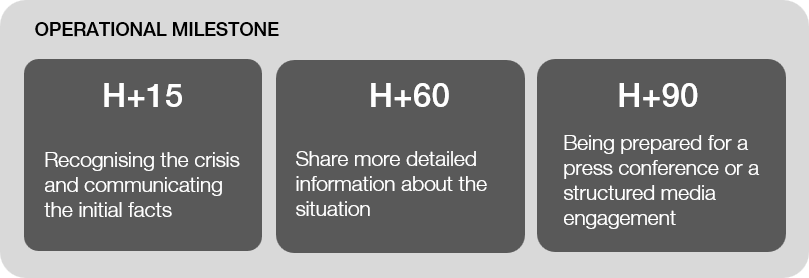
The operational reference benchmark in crisis communication rests on three non-negotiable time markers.
Every minute of silence belongs to someone else.
What This Means for You
AI did not invent the crisis, but it has changed its physics. The reaction window that still existed ten years ago — those precious few hours to consult, deliberate, and formulate — has closed. Today, when the acute phase arrives, it arrives already at its peak.
This narrowing of the dynamic has one direct consequence: preparation is no longer a luxury for large organizations — it is the only real room for maneuver that remains.
In practice, this means three things.
Anticipate before, not during. The most important decisions — who speaks, on which channel, with what key message, who approves — can no longer be made under pressure. They must be documented, tested, and known to all key actors well before any crisis occurs.
Rehearse regularly. A plan that has never been simulated is a plan that will not work. The crisis teams that perform are those that have already been through the posture, even artificially. Muscle memory matters as much as the written protocol.
Integrate the AI threat into your scenarios. Deepfakes, fake press releases, impersonation of executive voices: these scenarios are no longer theoretical. Your protocols must anticipate how you rapidly authenticate your official communications and how you respond to disinformation that targets you.
The good news: a prepared organization regains its capacity to act where an unprepared one is left reactive. The dynamic has accelerated for everyone — but the gap between those who have worked on their resilience and those who haven’t has never been wider.