

A crisis does not detroy
a reputation
Its bad response
does
Will your organisation be able to respond to a cyber-AI crisis?
Adapting Crisis Communication in
the AI Era
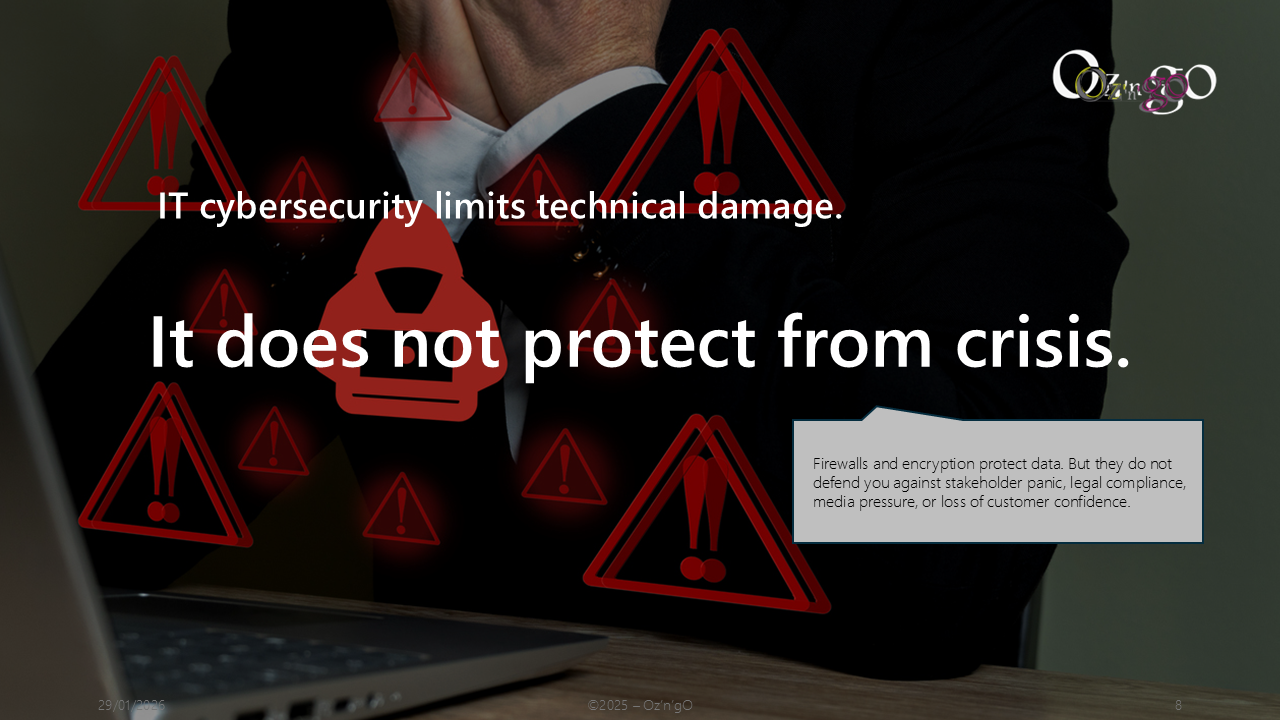
A cyberattack is not a crisis.
It is a technical incident. With AI, the attacks target the perception.
Everything happens then in
the human organisation
When governance and decision-making chains seize up, and when the credibility of messages erodes, the crisis gallops.
In practice, the same dysfunctions keep recurring:
CyberAI risks not identified
Rough, unsecured communication flows
Missing or unclear internal guidelines
Official content left unprotected
Weak signals ignored
Fragile crisis cells and plans — or none at all
Where do you stand today?
We offer a 30-minute conversation to assess your needs
and define a diagnostic genuinely tailored to your organisation.
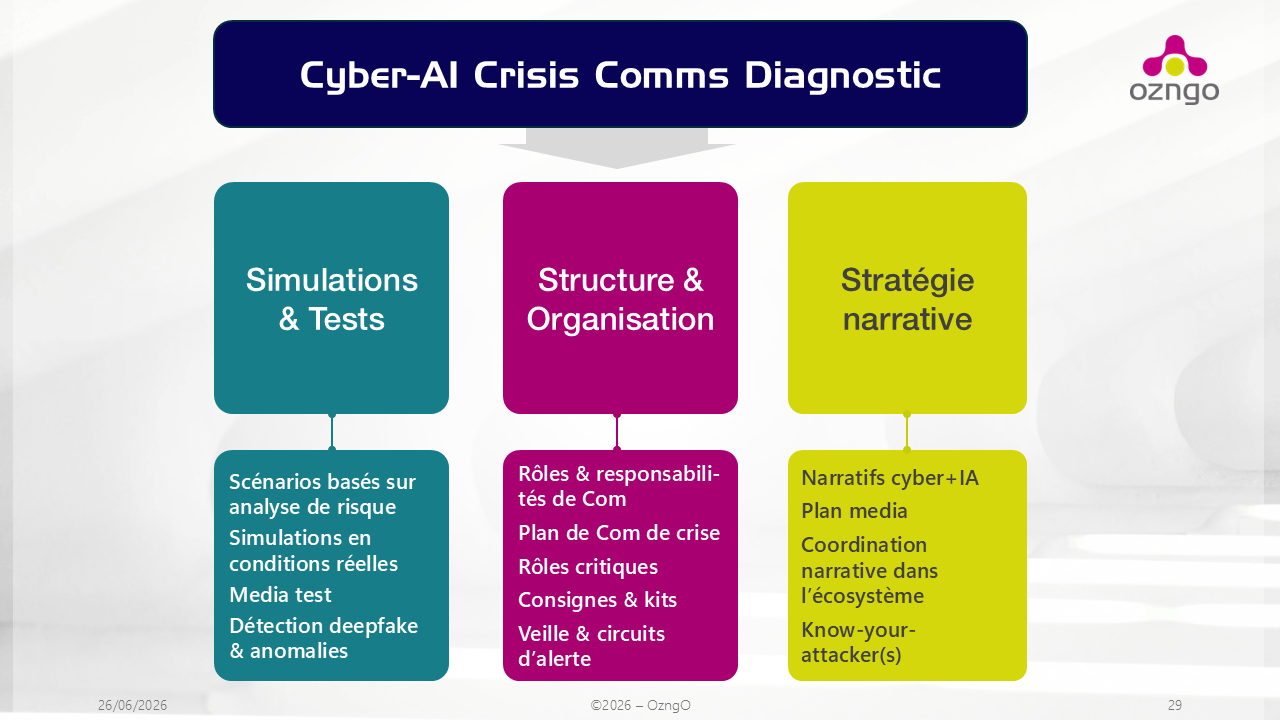
CyberAI Crisis Communication Offer
Disclaimer : Oz’n’gO’s engagements assume that the essential foundation of technical cybersecurity is already in place. If this is not the case, we bring in our experts, who will work alongside your existing technical partners.
The diagnostic referenced above is a comprehensive assessment of your level of preparedness, covering both organisational structure and communication readiness.
Need to strengthen your organisation ?
In-depth assessment, governance, simulations et preparation.
Need assistance?
Fill this questionnaire. We come back to you asap.
Preparing for crisis is necessary, not enough.
Crisis communication is the visible part of cybersecurity – not to be reduced to its technical dimension alone. Beneath that tip of the iceberge lies everything that determines whether your organisaiton will hold or crack under the pressure of a CyberAI attack designed to distort the very perceptions we rely on to make decisions.
Truth Governance
Protecting your data is good. Protecting your sensitive content – in every format, at every link in the chain – is another matter entirely.
In the AI era, the very notion of proof is collapsing. Deepfakes, forged documents, fabricated narratives blur our reference points. How do you react?
Resilience Culture Lab
An organisation that doesn’t cultivate collective resilience is vulnerable – not despite its teams’ skills, but because of its managerial blind spots.
Ambiguous leadership, silos, short-term performance pressure, resistance to AI – all theses are the entry points attackers target.
>>> our article on organisation resilience in an interdependent world where control is an illusion
One step to act.
One strategy to last.
Not a minute to lose.